Showing posts with label Kenya Courts. Show all posts

Kenya Civil procedure law

This Section gives you details on the civil procedure in Kenya under the civil procedure Act and civil procedure rules 2010.Below are some topics and a comprehensive introduction to the Kenya civil procedure law

Introduction to Civil Procedure law
Contents of the pre-litigation and litigation process
      • Grounds
      •  Capacity
      • Jurisdiction
        •  Residence
        • Cause of action
        • Where the dispute arose
        •  Quantum and nature of the claim
        • Consent
        •  Location of property
        • Jurisdiction in the High Court
    •  Demand
    • Time limits

      •  Actions
        •  Pleadings
        •  Summons 
        •  Particulars of claim
        •  Service of the summons
        • Default judgment
        • Notice of intention to defend
        •  Further particulars
        •  Declaration
        •  Defence
        • Exception
        •  Application to strike out
        •  Plea
        • Special plea
        • Counterclaim
        •  Replication and the plea in reconvention
        • Close of pleadings
        •  Pre-trial pleadings
        •  Variation and rescission of judgment
          • High Court
          •  Magistrate's Court
            •  Good cause
            •  Good reason
            •  Situations
          •  Summary of rescission of default judgment
      •  Applications
        •  Form
          • Notice of motion
          •  Affidavit
        • High Court
          •  General rule
          • Disputes of fact
          •  Resolving a dispute of fact
            • Dismissal of the application
            • Presentation of oral evidence
            • Referral to trial
          •  Notice to respondent
        •  Exceptions to the general rules
          •  Form of notice of motion
            •  Petitions
            • Ex parte applications
            •  Interlocutory applications
            •  Urgent applications
          •  Application notwithstanding existence of factual dispute
          •  Notice and service
        •  Appointment of curator
          •  Persons of unsound mind
            • Who may institute proceedings?
            • When application to court for appointment of a curator is unnecessary
            • When court proceedings must be instituted
            • How proceedings must be initiated
       An introduction to civil procedure law in Kenya
      Civil procedure in Kenya sets out the rules and standards that courts follow in that country when adjudicating civil suits (as opposed to procedures in criminal law matters). These rules govern how a lawsuit or
      Kenya criminal law:Transfer of cases between magistrates

      There are instances where a cases require to be transfered from one magistrate to another.This section outlines the rules that are followed during the transfer of this cases under the Kenya criminal law.

      Transfer of case where offence committed outside jurisdiction.
      The Kenya criminal procedure code Sec.78 states
      (1) If upon the hearing of a complaint it appears that the cause of complaint arose outside the limits of the jurisdiction of the court before which the complaint has been brought, the court may, on being satisfied that it has no jurisdiction, direct the case to be transferred to the court having jurisdiction where the cause of complaint arose.
      (2) If the accused person is in custody and the court directing the transfer thinks it expedient that custody should be continued, or, if he is not in custody, that he should be placed in custody, the court shall direct the offender to be taken by a police officer before the court having jurisdiction where the cause of complaint arose, and shall give a warrant for that purpose to the officer, and shall deliver to him the complaint and recognizances, if any, taken by the court, to be delivered to the court before whom the accused person is to be taken; and the complaint and recognizances, if any, shall be treated to all intents and purposes as if they had been taken by the last-mentioned court.
      (3) If the accused person is not continued or placed in custody, the court shall inform him that it has directed the transfer of the case, and thereupon the provisions of subsection (2) respecting the transmission and validity of the documents in the case shall apply.

      Transfer of cases between magistrates.
      The Kenya Criminal procedure code Sec. 79 provides for the rules to be used by magistrates when transfering cases.It states: "A magistrate holding a subordinate court of the first class -
      (a) may transfer a case of which he has taken cognizance to any magistrate holding a subordinate court empowered to try that case within the local limits of the first class subordinate courts’ jurisdiction; and
      (b) may direct or empower a magistrate holding a subordinate court of the second class who has taken cognizance of a case and whether evidence has been taken in that case or not, to transfer it for trial to
      himself or to any other specified magistrate within the local limits of his jurisdiction who is competent to try the accused and that magistrate.

      Transfer of part heard cases.
      Section 80 provides for rules in regard to a case that has been heard by one magistrate and requires to be continued by another magistrate.It states "If in the course of any trial before a magistrate the evidence appears to warrant a presumption that the case is one which should be tried by some other magistrate, he shall stay proceedings and submit the case with a brief report thereon to a magistrate holding a subordinate court of the first class empowered to direct the transfer of the case
      under section 79.

      Functions and Role of Kenyan Courts

      Courts exercise two types of jurisdiction over cases: original jurisdiction and appellate jurisdiction for cases previously heard in a lower court. Judges have the option, when hearing an appeals case, to reverse or remand a decision based on a violation of law like abuse of discretion.

      What Is the Court's Function in General?

      Whether it is dealing with two neighbors squawking over an overgrown shrub or sentencing a murderer to many years in prison, a court's function is essentially to keep the peace. A court, whether municipal, state or federal, is made up of an unbiased group of judges who hear testimony, weigh evidence and rule on the outcome of a civil or criminal trial.
      There are three levels of courts: municipal courts, state courts and federal courts. Each level of court exercises jurisdiction, or its authority to hear a case, based on a few factors. With attention to jurisdiction, we will study original and appellate jurisdiction in state and federal courts.

      Original Jurisdiction

      Keep in mind that no one state court behaves exactly as another, meaning state courts have different procedures and rules. As we learn about jurisdiction, we will focus on a general rule not specific to any one state.
      Again, jurisdiction is a court's authority to hear a case. There are two types of jurisdiction: jurisdiction over property and people, and subject matter jurisdiction.
      To keep things simple, jurisdiction over property is used to seize a valuable asset needed to make restitution to an injured party or to entice a defendant to appear in court. On the other hand, jurisdiction over people is decided based on whether a party to the suit lives in the forum state or the state in which the tort or criminal act took place.
      Subject matter jurisdiction is used based on the nature of the case. For instance, a murder trial will be heard in criminal court while divorce proceedings will be heard in family court (depending on the state).
      Sometimes, a defendant to a case lives outside of the forum state, or state to which the case is being tried. When this happens, long-arm statute is used to bring an out-of-state defendant to trial in the forum state.
      Bringing an out-of-state defendant to trial in another state is not cut and dry. Minimum contact with the forum state needs to be established. To say it a different way, to exercise jurisdiction over a defendant in a different state, the court must prove that this defendant has minimum contact in the forum state either by residence or business dealings.
      As an illustration, in International Shoe v. State of Washington (1945), International Shoe Company was a shoe manufacturer with its headquarters in Delaware and its manufacturing plant in Missouri. The state of Washington brought suit against International Shoe, a Delaware company with manufacturing done in yet another state, for unpaid employment tax for employees who resided in Washington State and worked for the company.
      Even though International Shoe did not conduct official business, like having official storefronts, in Washington, the state sought to collect taxes from the company by reason of minimum contact.
      In the end, minimum contact was established based on a few factors:
      • International Shoe salesmen who resided in Washington made regular wages
      • Salesmen set up mock stores where samples could be tried and orders were taken
      • The company benefited from the laws of Washington
      In sum, original jurisdiction can be extended over property and people as well as subject matter. Broad jurisdiction is typical of state courts. Appellate courts exercise a more limited jurisdiction over cases.

      Appellate Jurisdiction

      Appellate courts hear cases moved up from a lower court when one or more parties to a case is not satisfied with the lower court's ruling. Both federal and state appellate courts work in mostly the same way. Once a lower court has made a ruling, one or more of the parties may request that a higher court hear the case.
      Once the disgruntled party or parties files an appeal, this higher court will hear the case only if the issue for appeal stems from an issue of the application of law or where there was a violation of one's rights under the Constitution. No new evidence can be presented nor will a new trial, per se, take place.
      The judges or justices will review the ruling and rationale for the lower court judgment and make a decision to affirm, remand or reverse the ruling.

      Decisions, Decisions

      If a decision is affirmed, the higher court is simply confirming the decision of the lower court and no further action can be taken. A case is remanded when it is sent back to lower court for further action based on the judge's review and advice.
      In Gideon v. Wainwright (1963), a young, homeless Clarence Earl Gideon was tried and convicted of a misdemeanor crime in the state of Florida. At the time, Florida held that in exception of one's Sixth Amendment right to counsel, a misdemeanor crime did not qualify.
      As a result, Gideon unsuccessfully represented himself and was found guilty of petty larceny and burglary. While serving his prison term, Gideon began studying the law and discovered that his Sixth Amendment right was, in fact, violated.
      For that, Gideon filed a writ of habeas corpus, or a claim of false imprisonment, with the U.S. Superior Court on the basis of a violation of his constitutional rights. It was found that Gideon's right to counsel was violated.
      Gideon's case was remanded back to lower court where he was appointed an attorney to represent his rights. He was found not guilty.
      There are times when an appellate court actually reverses the decision of a lower court ruling by annulling the judgment made in a previous trial because there was a violation of law or constitution. Specifically, in Lochner v. State of New York (1905), the state of New York restricted the number of hours a bakery employee could work to less than 60 hours a week.
      Lochner, a baker out of Utica, New York, argued that the law restricted the products he could produce, thereby violating his Fourteenth Amendment to right to life, liberty or property without due process. The state of New York claimed that having workers exceed 60 hours was dangerous, and they required ample rest between shifts.

      Structure of Kenyan Courts Under the New Constitution


      Kenya is a country in which the Judiciary of Kenya is the system of courts which interprets as well as applies the law.  There are courts both at the federal level and the state level and each is responsible for its own set of functions and responsibilities.
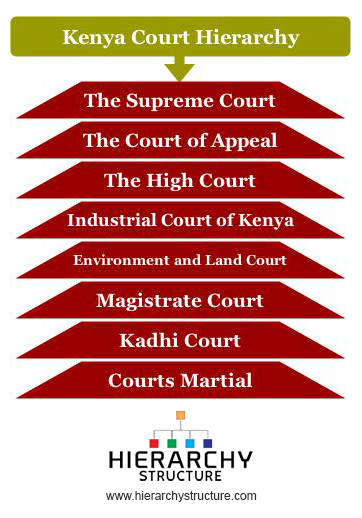
      The entire court system is divided into a hierarchical system wherein the superior courts consist of Supreme Court, Courts of Appeal, High court and Industrial court etc. whereas the subordinate courts are made up of Magistrate court, Kadhi court and others. To understand the hierarchical system of courts in Kenya, you can read the following given information.

      Kenya Court HierarchyTHE SUPERIOR COURTS

      The Supreme Court

      The Supreme Court is the Apex court which is comprised of the Chief Justice, The President, the deputy chief justice and five other judges.  The word of the Supreme Court is final and cannot be negated by any other court. All the other courts fall beneath this court.

      The Court of Appeal

      This is the court which handles the appeal cases from the High court as well as those as prescribed by the President.  This court comprises of not less than 12 judges and is headed by the President who is appointed by the Chief Justice.

      The High Court

      This court has the supervisory jurisdiction over all the lower or subordinate courts and other persons.

      Industrial Court of Kenya

      Next in the hierarchy of the Superior courts in Kenya comes the Industrial court of Kenya which was established for the purpose of handling issues or cases related to employment and industrial relations etc.

      Environment and Land Court

      This court is responsible for hearing and settling disputes which are related to the environment.

      THE SUBORDINATE COURTS

      Magistrate Court

      This is the case where the majority of judiciary cases are heard and these courts are located in each of the district of Kenya.  A chief magistrate heads each of the courts and some others who are part of this court are the Senior Principal Magistrate, Senior Resident Magistrate, Resident Magistrate and others.

      Kadhi Court

      This is the court which is responsible for hearing civil and criminal matters which are related to Islamic law.  This court is headed by a chief Kadhi

      Courts Martial

      This is the military court of Kenya which mostly hears or settles those cases which are related to the Kenya Defense Forces. Appeals that move on from this court are heard by the High court.

      Full List of High Courts in Kenya

      High Court of Kenya

      In the new Constitution, the High Court of Kenya will have a Principal Judge elected by fellow judges of the High Court from among themselves. It will have unlimited original jurisdiction in criminal and civil matters; jurisdiction to determine whether a right or fundamental freedom in the Bill of Rights has been denied or violated and jurisdiction to hear an appeal from a decision of a tribunal to consider the removal of a person from office.
      The High Court of Kenya also has jurisdiction to hear questions on the interpretation of the Constitution and constitutional powers of State organs in respect of county governments and the constitutional relationship between the levels of government. Such matters will be heard by an uneven number of judges — not less than three — assigned by the Chief Justice.
      The judges will be appointed by the President with the recommendation of the Judicial Service Commission.

      High Court of Kenya – Overview

      The High Court of Kenya is established under article 165 of the constitution of Kenya. It has supervisory jurisdiction over all other subordinate courts and any other persons, body or authority exercising a judicial or quasi-judicial function. It was known as the Supreme Court of Kenya until 1964 and its name has remain unchanged since then.
      The High Court has jurisdiction to hear all criminal and civil cases as well as appeals from the lower courts. The High Court comprises a maximum of 150 judges and has original jurisdiction in all criminal and civil matters. The High Court is a premier court in interpreting the Constitution, hears appeals from subordinate courts and tribunals and supervises all administrative bodies (judicial review).
      High Court divisions include Family, Commercial and Admiralty, Constitutional and Judicial Review, Land and Environment, Criminal, Industrial and Environmental and Land Court. There are at least 20 High Court stations countrywide.
      The Constitution has also established the Industrial Court and the Land and Environment Court at the same level as the High Court. Industrial Court deals with labour and employment matters while the Land and Environment Court deals with land and environment matters and appeals from all tribunals dealing in land and environment matters.
      To access High Court Cause List, Visit http://kenyalaw.org/kl/
      High Court of Kenya
      High Court of Kenya

      High Courts of Kenya

      Bungoma High Court of Kenya

      Address: P.O.BOX 365 Bungoma
      Officer in Charge: Resident Judge
      Telephone: 0730-186100
      Email: bungomahighcourt@judiciary.go.ke

      Eldoret High Court of Kenya

      Address: P.O.BOX 141 Eldoret
      Officer in Charge: Resident Judge
      Telephone: 0730-184200
      Email: eldorethighcourt@judiciary.go.ke

      Embu High Court of Kenya

      Address: P.O.BOX 256 Embu
      Officer in Charge: Resident Judge
      Telephone: 0730-183600
      Email: embuhighcourt@judiciary.go.ke

      Garissa High Court of Kenya

      Address: P.O.BOX 68 Garissa
      Officer in Charge: Resident Judge
      Telephone: 0730-183000
      Email: garissahighcourt@judiciary.go.ke

      Kakamega High Court of Kenya

      Address: P.O.BOX 22 Kakamega
      Officer in Charge: Resident Judge
      Telephone: 0730186000
      Email: kakamegahighcourt@judiciary.go.ke

      Kerugoya High Court of Kenya

      Address: P.O.BOX 17 Kerugoya
      Officer in Charge: Resident Judge
      Email: kerugoya.highcourt@judiciary.go.ke

      Kisii High Court of Kenya

      Address: P.O.BOX 69 Kisii
      Officer in Charge: Resident Judge
      Telephone: 0730-187100
      Email: kisiihighcourt@judiciary.go.ke

      Kisumu High Court of Kenya

      Address: P.O.BOX 126 Kisumu
      Officer in Charge: Resident Judge
      Telephone: 0730-187000
      Email: kisumuhighcourt@judiciary.go.ke

      Kitale High Court of Kenya

      Address: P.O.BOX 641 Kitale
      Officer in Charge: Resident Judge
      Telephone: 0730-185000
      Email: kitalehighcourt@judiciary.go.ke

      Machakos High Court of Kenya

      Address: P.O.BOX 145 Machakos
      Officer in Charge: Resident Judge
      Telephone: 0730-183800
      Email: machakoshighcourt@judiciary.go.ke

      Malindi High Court of Kenya

      Address: P.O.BOX 2 Malindi
      Officer in Charge: Resident Judge
      Telephone: 0730-182700
      Email: malindihighcourt@judiciary.go.ke

      Meru High Court of Kenya

      Address: P.O.BOX 118 Meru
      Officer in Charge: Resident Judge
      Telephone: 0730-183400
      Email: meruhighcourt@judiciary.go.ke

      Milimani High Court of Kenya

      Address: P.O.BOX 30041 Nairobi
      Officer in Charge: Resident Judge
      Telephone: 0730-181000
      Email: milimani.highcourt@judiciary.go.ke

      Mombasa High Court of Kenya

      Address: P.O.BOX 90140 Mombasa
      Officer in Charge: Resident Judge
      Telephone: 0730-182300
      Email: mombasahighcourt@judiciary.go.ke

      Muranga High Court of Kenya

      Address: P.O.BOX 146 Muranga
      Officer in Charge: Resident Judge
      Email: muranga.highcourt@judiciary.go.ke

      Nakuru High Court of Kenya

      Address: P.O.BOX 61 Nakuru
      Officer in Charge: Resident Judge
      Telephone: 0730-184900
      Email: nakuruhighcourt@judiciary.go.ke

      Nyeri High Court of Kenya

      Address: P.O.BOX 70 Nyeri
      Officer in Charge: Resident Judge
      Telephone: 0730-184200
      Email: courtofappealnyr@judiciary.go.ke